

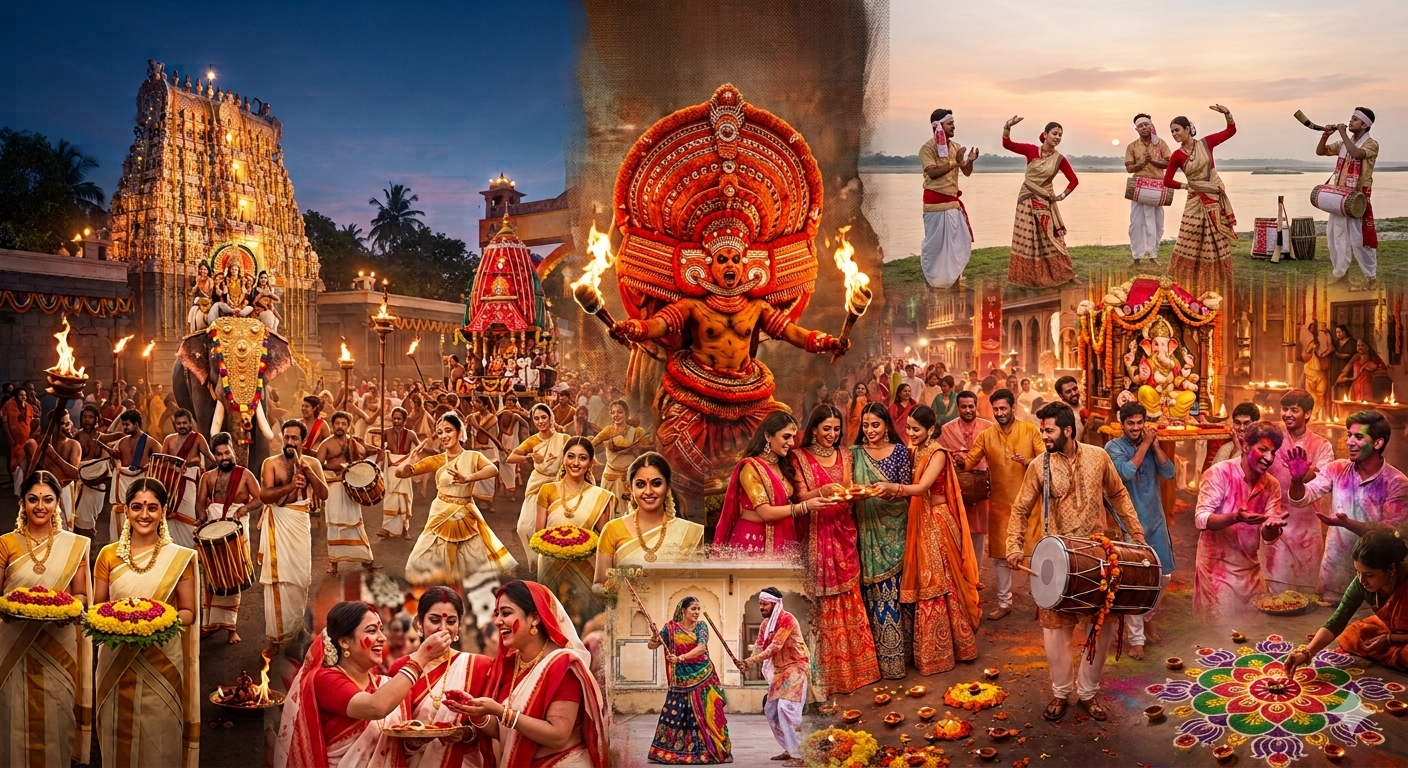
The Dialectic of Desi and Marga: Globalization, Cultural Entropy, and the Metamorphosis of India's Regional Festivals
The civilizational cohesion of the Indian subcontinent has historically eluded the taxonomies of Western political and religious theory. Where European nation-states sought unity through enforced doctrinal uniformity, linguistic standardization, and centralized institutional authority, Indic civilization established an architectural equilibrium rooted in dynamic pluralism. At the heart of this cultural organism lies the dialogue between Marga—the trans-regional, contemplative, and formal pathway—and Desi—the regional, vernacular, contextual, and autochthonous expression. As demonstrated in Bharata Muni’s foundational Natya Sastra and systematically articulated by twentieth-century scholars such as Kapila Vatsyayan, Marga and Desi never represented a rigid hierarchy of the classical subjugating the folk. Rather, they operated as an unbroken, reciprocal continuum in which regional practices constantly replenished universal forms, while universal idioms provided a metaphysical scaffolding within which localized expressions flourished.
Within this matrix, festivals (utsavas and parvas) functioned not merely as recreational pauses in agrarian life, but as the physical manifestation of Rta—the cosmic, moral, and natural order. In his foundational essay Swadeshi Samaj, Rabindranath Tagore observed that festivals in India were organic mechanisms through which the collective mind (samaja) revitalized its relationship with the seasons, the soil, the ancestors, and the transcendent. Tagore posited that whereas Western civilization preserved its social cohesion primarily within state institutions, India preserved her vital forces within communal utsavs and melas. These gatherings were self-organizing sanctuaries of spiritual rejuvenation where differences in caste, wealth, and status were softened through shared aesthetic delight and ritual participation.
The integrity of this cultural continuum depended upon the sanctity of regional variations. Whether marking the northward transit of the sun, the harvest of summer grain, or the vernal awakening of the earth, festivals were anchored in distinct micro-ecologies (desa), specific temporal moments (kala), and immediate community vessels (patra). The broader Hindu identity was never an abstract, flattened monolith imposed from above; it was the cumulative synthesis of localized celebrations that shared a common metaphysical grammar while speaking in autonomous vernacular dialects. The vital fluid of the tradition circulated through this decentralized network. To dissolve regional specificity in the name of homogenization is to sever the subterranean roots that sustain the entire civilizational tree.
Dimension | The Desi Paradigm (Vernacular Praxis) | The Marga Continuum (Trans-Regional Matrix) | Late-Capitalist Monoculture |
Ontological Locus | Micro-ecological; rooted in desa (soil), local flora, and seasonal transitions. | Universalized archetype; grounded in Vedic, Puranic, and sastric structures. | Homogenized media consumer market; detached from geographic micro-climate. |
Epistemic Transmission | Oral memory, bodily praxis, hereditary guild lineage, and domestic participation. | Codified texts, liturgical canons, sastras, and classical philosophical treatises. | Digital screens, commercial advertising, reality programming, and state curricula. |
Community Agency | Direct, unmediated communion; dissolving of social hierarchies through collective ritual. | Civilizational integration; providing a shared metaphysical vocabulary across boundaries. | Passive consumption; audience transformed into spectator and consumer. |
Material Base | Locally harvested organic matter (clays, cow dung, forest barks, indigenous crops). | Consecrated icons, temple architecture, formal altars, and sacred geometry. | Factory-manufactured plastics, toxic chemical paints, and mass-market consumer goods. |
The Morphological Rupture: Regional Case Studies
Over the past half-century, the socio-ecological landscape of rural and semi-urban India has experienced tectonic disruptions. Rapid urbanization, rural-to-urban migration, environmental degradation, and digital networks have combined to erode the localized ritual calendars that once governed daily life. Across diverse geographic regions, local festivals are either fading away or undergoing severe structural transformation, shifting from participatory communitarian sacraments into curated, commercialized spectacles.
Cultural Matrix & Region | Traditional Locus & Praxis | Cosmic & Ecological Rationale | Contemporary Structural Metamorphosis | Primary Pathological Vector |
Bohag Bihu
(Assam & Brahmaputra Valley) | Open fields (Mukoli) and household courtyards (Husori); cattle bathing and veneration (Goru Bihu). | Vernal fertility; cattle health via medicinal plants (dighloti, makhi-yati); phototactic insect control. | Shift to "Stage Bihu" (Mancha Bihu); competitive choreography, electronic pop instrumentation. | Institutionalization; loss of agrarian ecological context in favor of televised competition. |
Theyyam
(North Malabar, Kerala) | Sacred ancestral groves (kavu); trance possession (parakaya pravesanam) by Dalit performers. | Ancestor propitiation; embodiment of local devatas; subversion of caste; localized village jurisprudence9. | Performances staged at luxury beach resorts, cultural centers, and international tourism showcases. | Cultural commodification; reduction of sacred trance and mediumship to aesthetic entertainment. |
Raja Parba
(Coastal & Inland Odisha) | Village courtyards and mango groves; rope swings (Raja Doli); ban on plowing or disturbing soil. | Consecration of Mother Earth's (Bhudevi) menstruation; rest of soil prior to monsoon sowing; honoring womanhood. | Retail shopping festivals in urban malls; commercial packaging and fast-food delivery of Poda Pitha. | Corporate retail co-optation; complete decoupling of celebration from agrarian rest and soil ecology. |
Sarhul & Karam
(Jharkhand & Chota Nagpur) | Sacred Sal groves (sarna); water-pot prophecy by the Pahan; reverence for Karam branches. | Ecological reciprocity; floral flowering of Sal; moral myth of ancestral balance with forest resources. | Urbanized street rallies; displacement from ancestral groves; political identity displays. | Deforestation; open-cast mining; dissociation of tribal youths from traditional agrarian lifeways. |
Sanjhi
(Braj, Punjab, & Haryana) | Earthen walls of village homes; stenciled dry-powder temple mandalas over water or stone. | Twilight rites of the feminine divine; celebration of seasonal changes; temple lila devotion. | Rapidly disappearing from domestic walls; preserved only in a handful of ancestral Vrindavan temples. | Urban architectural modernization (cement walls); extinction of hereditary stencil-cutting lineages. |
Phool Dei
(Garhwal & Kumaon Himalayas) | Alpine village thresholds; children scattering wild rhododendron (buransh) and mustard flowers. | Himalayan vernal awakening; child-led ecological blessings; inter-household social solidarity. | Retreat into tokenized administrative festivals or school programs; vanishing from village life. | Rural out-migration; creation of abandoned "ghost villages"; climate disruption of mountain flora. |
In Assam, the arrival of the spring equinox was traditionally marked by Bohag Bihu (or Rongali Bihu), a multi-day festival complex uniting Austro-Asiatic, Tibeto-Burman, and Indo-Aryan cultural strands into a shared seasonal rhythm. The festival began with Goru Bihu, an ecologically grounded rite honoring domestic cattle, where herds were washed with wild herbs and struck gently with sprigs of dighloti and makhi-yati to repel parasites, directly encoding traditional veterinary care and pest management. The communal celebration unfolded as Mukoli Bihu in forest groves and Husori in village courtyards, where elders and youth visited homes to sing blessings with the dhol, pepa, and gogona.
The transition to the urban proscenium accelerated with the inauguration of "Stage Bihu" (Mancha Bihu) at Guwahati's Latasil playground in 1952. Over subsequent decades, driven by television broadcasting and corporate-sponsored cash awards, Bihu underwent a structural transformation.
The seasonal fertility dance transitioned into a synchronized, hyper-choreographed competitive performance under halogen lights. In this urban format, improvisational community dance is restricted by strict time limits and accompanied by electronic synthesizers. While Bihu remains a core component of Assamese public identity, its agrarian foundations and relationship with the soil have been eclipsed by stage performance aesthetics.
In the North Malabar region of Kerala, Theyyam represents an ancient intersection of ancestor propitiation, animistic forest cults, and esoteric Shakta-Shaiva metaphysics. Anchored in the sacred groves (kavus), Theyyam is an act of parakaya pravesanam, a sacrificial transformation wherein performers from historically oppressed castes (such as the Vannan, Malayan, and Velan) undergo austerities to become living vessels for the divine.
When the towering headpiece (mudi) is fixed onto the performer and he looks into the mirror, his ordinary personality gives way to the devata. In this space, feudal hierarchies are temporarily overturned: upper-caste patrons stand with palms joined before the subaltern deity to seek counsel, expiation, and justice.
The modern tourism industry has steadily detached Theyyam from this ancestral environment. The sacred groves, which serve as crucial reservoirs of local biodiversity, are often sidestepped as performers are booked for secular cultural centers, trade expos, and luxury resorts.
Reduced to an exotic visual spectacle featuring towering costumes and fire leaps, the ritual is stripped of its jurisdictional authority and its communion with the departed. The tourist gaze consumes the outward choreography while remaining disconnected from the metaphysical presence (sannidhana) that gives the ritual its transformative weight.
In Odisha, the three-day festival of Raja Parba, observed during Mithuna Sankranti in mid-June, centers on a profound ecological idea: the cyclical menstruation of Mother Earth (Bhudevi). Tied to the agrarian calendar, the tradition requires that the earth be allowed to rest before the onset of monsoon sowing.
All agricultural labor stops; plowing, digging, and disturbing the soil are prohibited. Women and young girls—regarded as living expressions of this natural fertility—are relieved of household duties and cooking. They adorn their feet with crimson alata, sing Raja Gita, share slow-cooked Poda Pitha, and ride rope swings (Raja Doli) suspended from village trees.
In modern urban centers like Bhubaneswar, this seasonal framework has been widely co-opted by commercial interests. Modern apartment complexes leave little room for village swings, and the festival has been adapted into a retail event by shopping malls and retail chains. Packaged varieties of Poda Pitha are sold through online delivery platforms, turning a communal period of rest and feminine solidarity into a consumer event. The festival's central message—that human production must pause to honor the earth's natural regenerative cycles—is frequently lost in the push for consumer activity.
A similar decline is visible in smaller seasonal and domestic rituals across northern India. In the Braj countryside, Punjab, and Haryana, the autumnal festival of Sanjhi involved girls hand-sculpting clay and cow-dung reliefs on courtyard walls to honor the twilight goddess. In the historic shrines of Vrindavan, Sanjhi was elevated into a specialized devotional art form, with temple priests using intricate hand-cut stencils to compose dry-powder landscapes over water to depict Krishna's lilas.
Today, modern plaster walls, urban apartment living, and the migration of craft families into commercial trades have brought domestic Sanjhi close to extinction, while its temple counterpart survives in only a few shrines under severe economic strain.
In the Himalayan foothills of Uttarakhand, the spring festival of Phool Dei saw children gathering wild rhododendron and mustard blooms to scatter upon neighborly thresholds as a blessing for the new year. Widespread rural-to-urban migration has emptied hundreds of mountain villages, turning this domestic community ritual into a state-sponsored performance or an occasional school exercise.
Across the central tribal belt of Jharkhand, festivals like Sarhul and Karam suffer from the steady loss of their physical environments4. The Pahan (village priest) reading water levels in earthen pots to predict the monsoon rains, the distribution of fresh Sal blossoms (phool khonsi), and the reverent cutting of the Karam tree branch are disrupted by mining projects, industrialization, and urban resettlement. As the sacred groves (sarnas) are cleared, the living link between human community and forest ecology breaks down, leaving behind simplified public processions separated from their original ecosystems.
Theoretical Framing: Commodification, Spectacle, and the Erasure of Aura
To analyze the mechanisms driving this transformation, one must turn to both indigenous sociological formulations and Western cultural theory. The decline of regional festivals is not merely an aesthetic evolution; it represents a fundamental shift in how human communities generate meaning and understand their place in the cosmos.
In his classic field studies of Indian rural life, McKim Marriott formulated the concepts of universalization and parochialization to describe the dynamic interaction between the "Great Tradition" of Sanskritic civilization and the "Little Tradition" of village communities. Universalization occurred when local, indigenous deities, rites, and stories were gradually integrated into trans-regional Sanskritic literature and iconography. Conversely, parochialization occurred when universal motifs were translated downward into regional vernaculars, adopting the linguistic styles, seasonal crops, and social textures of specific locales.
Under late-stage globalization, this reciprocal exchange has largely been replaced by monocultural standardization. Regional practices are no longer in active dialogue with the cosmic archetypes of Marga; instead, both are bypassed by commercial templates propagated through mass media and retail consumerism.
This trend is fundamentally distinct from classical Sanskritisation, a concept developed by M. N. Srinivas to describe how lower castes adopted Brahminical customs and rituals to pursue upward social mobility. Sanskritisation, whatever its social tensions, took place within a shared sacred universe that recognized karma, ritual purity, and cosmic order. The contemporary trend, by contrast, is a secular-commercial standardization driven by capital flows, market logistics, and digital reproduction, replacing local ritual diversity with uniform consumer habits.
This process mirrors the framework outlined by Guy Debord in The Society of the Spectacle. Debord observed that modern commodity capitalism systematically replaces lived human experience with passive representation. In the traditional Indic festival, the participant embodied the sacred: the Theyyam performer was the deity, the Odia maiden was the consecrated earth, and the Assamese youth singing Husori was a medium of ancestral blessing.
Under early industrial consumerism, participation shifted from being to having, where ritual presence was signaled by purchasing commodities like manufactured textiles and factory-made sweets. In the contemporary media landscape, this has shifted entirely to appearing. The festival is reimagined as an aesthetic display to be photographed, shared online, and marketed for tourism.
This transition matches Walter Benjamin’s critique of the erosion of "aura" in The Work of Art in the Age of Mechanical Reproduction. For Benjamin, the aura of a traditional artifact or ritual resides in its unique presence in time and space, anchored within a specific fabric of cultic utility. When a festival like Theyyam or Bihu is severed from its geography—the sacred grove or the open agrarian field—and reproduced for television screens or hotel audiences, its cultic aura is lost.
The ceremony is converted into what Jean Baudrillard termed a simulacrum—a copy that bears no relation to any underlying sacred reality. The modern observer encounters an event labeled "Theyyam" or "Bohu Bihu," but the living relationship with the land, the spirits, and the ancestors has been hollowed out, leaving only an aesthetic shell.
The Indological Critique: Coomaraswamy, Bose, and the Degradation of Utility
The philosophical dimensions of this cultural displacement were anticipated by Ananda Kentish Coomaraswamy. In works such as Christian and Oriental Philosophy of Art and The Dance of Shiva, Coomaraswamy challenged the modern Western separation of beauty from functional, everyday utility, alongside the bourgeois idea of "art for art's sake". He maintained that in traditional Indian life, art, ritual, and manual labor were never divided into separate sacred and secular compartments. The clay vessel shaped for seasonal worship, the earthen wall decorated for Sanjhi, and the bamboo flute played for Bihu possessed an intrinsic intelligibility—a shared symbolic language that communicated metaphysical truths directly to the community.
Coomaraswamy warned that when industrial capitalism and Western-style commercial education enter traditional societies, they dismantle this organic unity. By replacing handmade community artifacts with cheap, factory-made goods and marginalizing ancestral knowledge, modern systems render traditional craftsmen economically precarious and the community spiritually disconnected from its own rituals. Coomaraswamy’s central insight was that the modern world reduces sacred traditions to sentimental entertainment, transforming rites of renewal into museum relics or commercial spectacles.
Complementing Coomaraswamy’s cultural analysis is the sociological work of Nirmal Kumar Bose. In his 1941 formulation of "The Hindu Method of Tribal Absorption," Bose noted that the historical integration of diverse tribal and indigenous communities into the wider Indian civilizational fold occurred primarily through economic accommodation rather than forced doctrinal assimilation. According to Bose, the decentralized social framework allowed communities to retain their autonomous customs, seasonal festivals, and forest deities while participating in regional economic life.
While subsequent scholars like Tarak Chandra Das and modern anthropologists have re-evaluated Bose for downplaying social stratification and moments of cultural friction, Bose accurately highlighted a defining civilizational dynamic: the Indic tradition historically accommodated a plurality of liturgical practices. The indigenous reverence for the Sal tree in Sarhul or the Karam bough in Karam Puja was never eradicated; it was embraced as a legitimate expression of the sacred.
The historical ability to incorporate local celebrations within a decentralized cultural continuum is now challenged by global market forces. Corporate consumerism requires operational uniformity; it struggles to accommodate unmonetized, place-based expressions of community life.
The Stasis-Mutation Dilemma: Dynamic Survival versus Museumification
This transformation raises a central theoretical problem for contemporary Indology: whether the altered, commercialized survival of an ancient festival is preferable to preserving its original form in artificial stasis, where it risks eventual obsolescence.

One response to cultural erosion is the impulse toward strict preservation, often leading to museumification or the creation of cultural reservations. Championed by administrative bodies, tourism departments, and international heritage organizations, this approach seeks to freeze rituals in an idealized form. Festivals are moved into auditoriums, cultural heritage complexes, or competitive arenas. Practitioners are classified as heritage bearers, and their living customs are codified into fixed repertoires to protect them from external influence.
This preservationist model often mistakes preservation for taxidermy. A living tradition (sampradaya or parampara) is inherently dynamic (pravaha). When a ritual is severed from its ecological base, its agricultural seasons, and its communitarian obligations, it loses its vital character. It becomes an exhibit. The younger generation, encountering these preserved forms disconnected from their lived realities, often views them as irrelevant curiosities. Rituals preserved only through artificial sponsorship typically decline once the older practitioners pass away. Stasis does not preserve life; it merely memorializes a tradition that has ceased to breathe.
At the opposite extreme is the view that any commercial modification is a welcome sign of cultural resilience. From this market-oriented perspective, the staging of Theyyam in hotels, the conversion of Bohag Bihu into televised competitions, and the transformation of Raja Parba into retail campaigns are cited as proof of cultural vitality. This outlook overlooks the risk of qualitative decay. There is a fundamental difference between organic adaptation—where the external form changes to protect the underlying sacred purpose—and degenerative co-optation—where the outer shell is preserved as a commercial novelty while its spiritual and communal core is hollowed out.
When Bihu is reimagined primarily as a stage contest, the kinetic movements survive, but the shared communal blessings, the honoring of work animals, and the celebration of the soil are discarded. The festival retains its outward name and visual appearance, but its inner meaning (bhava) is replaced by commercial display.
To navigate beyond this choice between institutional stagnation and commercial erosion, one can turn to the insights of Sri Aurobindo. In The Renaissance in India and The Foundations of Indian Culture, Aurobindo warned against two traps that have historically endangered Indian civilization:
1. The condition of tamas—an unyielding immobility that clings to outdated outer forms simply because they are old, which results in petrifaction.
2. The error of mechanical mimesis—an uncritical adoption of Western commercial and utilitarian structures that sever a people from their spiritual foundations.
Aurobindo argued that Indic civilization survived historically because of its capacity for organic assimilation and dynamic self-renewal: the living spirit of the culture is an evolving organism that cannot be saved by barricading it inside past conventions, but by continuous spiritual self-expression through responsive, evolving forms.
Through this perspective, genuine continuity requires neither fossilization nor commercial surrender. It demands that a community reconnect with the essential spirit (svabhava) and moral foundation (dharma) of its rituals, allowing the external expressions (rupa) to adjust naturally to the needs of the current era (yuga-dharma) while keeping their sacred and communitarian core intact.
The Horizon of Sovereign Communal Reclamation
The decline of regional festivals under modern economic and technological pressures is not entirely inevitable. From a mechanistic, purely economic viewpoint, as long as industrialization displaces rural populations, alters agricultural ecosystems, and reorients social life around individual digital consumption, localized festivals will struggle to survive in their traditional forms. When the agrarian field is converted into a highway, the sacred grove leveled, and local dialects marginalized by global mass media, the material basis supporting the seasonal festival is deeply undermined.
However, Indic thought views time as cyclical (chakra) rather than linear and deterministic. The current consumer paradigm is not the final chapter of human culture; its environmental tolls, psychological alienation, and cultural exhaustion are already sparking widespread introspection. The renewal of regional festivals will not come from nostalgic retreat or state-funded museumification. It depends upon what may be termed sovereign communal reclamation.
This reclamation begins with ecological re-anchoring: festivals must be reconnected to environmental stewardship. Raja Parba must be recovered as a movement to protect soil health, preserve open spaces, and celebrate natural biological cycles, resisting reduction to a retail shopping event. Sarhul must remain tied to the defense of the Sal forests, the restoration of community woodlands, and the protection of tribal lands.
Communities must also reclaim the boundaries of the ritual space from the commercial stage. As many traditional practitioners have argued, sacred rites of mediumship and possession cannot be commodified as tourist spectacles without losing their spiritual authority. The boundaries of the sacred grove (kavu) and the village altar must be protected, ensuring that the ritual remains a space where the divine speaks to the needs and trials of the local community.
Finally, the dialogue between Desi and Marga must be actively renewed. Scholars, practitioners, and community elders must rebuild the bridges connecting vernacular rituals with the broader metaphysical philosophy of Indic civilization. When a community recognizes that its regional traditions are expressions of universal cosmic principles, the pressure to dilute those customs for commercial entertainment diminishes.
Festivals will naturally evolve over time, as change is an inherent condition of life (samsara). The critical issue is the locus of that transformation. If change is imposed externally by commercial interests, television networks, and tourism boards, the festival will be reduced to an empty commodity. But if adaptation comes from within—from the living consciousness of the community, rooted in its ancestral soil and sacred traditions—regional festivals will continue to endure as the essential threads that sustain the living, diverse tapestry of Indian civilization.
Works cited
1. Classical Indic Music I: Saastriya Sangeeta Tradition, https://indicportal.org/classical-indic-music-i-saastriya-sangeeta/
2. (PDF) Hinduism in India: Modern and Contemporary Movements, https://www.researchgate.net/publication/312042544_Hinduism_in_India_Modern_and_Contemporary_Movements
3. The Idea of Mela and Utsav in Secular Form: Rabindranath Tagore, https://www.researchgate.net/publication/380638057_The_Idea_of_Mela_and_Utsav_in_Secular_Form_Rabindranath_Tagore_and_His_Santiniketan
4. Tribal Festivals: Celebrations of Life, Nature, and Community, https://philosophy.institute/tribal-philosophy/tribal-festivals-celebrations-community/
5. Bihu Of Assam: A Folk Festival As Praxis Of Ecological, Social, And, https://www.ijcrt.org/papers/IJCRT2606492.pdf
6. Ananda K. Coomaraswamy - Authors | World Wisdom, https://worldwisdom.com/author/ananda-k-coomaraswamy/
7. Ananda Coomaraswamy - Wikipedia, https://en.wikipedia.org/wiki/Ananda_Coomaraswamy
8. Bihu Dance and the Question of Authenticity: Examining the Crisis of, https://www.creativeflight.in/2025/10/bihu-dance-and-question-of-authenticity.html
9. Theyyam - An Explained Study | PDF - Scribd, https://www.scribd.com/document/1006734269/Theyyam-An-Explained-Study
10. The Dual Faces of Cultural Tourism: Natural Essence vs. Contrived, https://thetourism.institute/tourism-impacts/cultural-tourism-natural-vs-contrived-experiences/
11.Performing arts, diaspora and identity: the case of Theyyam, https://ebrary.net/173957/education/performing_arts_diaspora_identity_case_theyyam_performances_indian_diaspora
12. This monograph on the tradition and practice of Sanjhi in ... - IGNCA, https://ignca.gov.in/PDF_data/kp_02_pre.pdf
13. Odisha Celebrates Raja Parba: A Festival of Earth and Womanhood, https://bumppy.com/news/odisha-celebrates-raja-parba-a-festival-of-earth-and-womanhood/
14. Full text of "The Cultural Heritage Of India Vol. 7 Part.1 Ed.1st", https://archive.org/stream/in.ernet.dli.2015.148997/2015.148997.The-Cultural-Heritage-Of-India--Vol-7-Part1-Ed1st_djvu.txt
15. Book Christian and Oriental Philosophy of Art Ananda Coomaraswamy, https://www.bookdelivery.com/il-en/book-christian-and-oriental-philosophy-of-art/9781621389859/p/56604982
16. A Brief Back-Story Of Bihu - The Hills Times, https://thehillstimes.in/featured/a-brief-back-story-of-bihu
17. Evolution of Bihu-Nach - NEZINE, https://www.nezine.com/info/TUhCblFUMGd5S29oQlN6WFY1RGg1Zz09/evolution-of-bihu-nach.html
18. Theyyam Cultural Log | PDF | Kerala | Deities - Scribd, https://www.scribd.com/document/1060750896/Theyyam-Cultural-Log
19. Kṛṣṇanāṭṭam Performance: Kṛṣṇa Devotion, Ritual Ecology, https://www.mdpi.com/2077-1444/16/12/1503
20. Raja Sankranti — June 14–16, 2027 - National Today, https://nationaltoday.com/raja-sankranti/
21. Pahili Day — June 14, 2027 | National Today, https://nationaltoday.com/pahili-day/
22. Munda Tribe: Culture and Governance Insights | PDF - Scribd, https://www.scribd.com/document/465812135/Munda-Tribes-Traditional-Practices-And-Local-Governance
23. Navaratri - Wikipedia, https://en.wikipedia.org/wiki/Navaratri
24. Festivals of Braja and Vrindavan | PDF - Scribd, https://www.scribd.com/document/128113643/Braja-and-Vrindavan-Festivals
25. Skill Gap Study, https://hcssc.in/wp-content/uploads/2026/06/SKILL-GAP-STUDY-BOOK-HCSSC.pdf
26.(PDF) The transformation of the custom of Bihu dance prevalent, https://www.researchgate.net/publication/359682483_The_transformation_of_the_custom_of_Bihu_dance_prevalent_among_the_Koiborta_community_of_Nagaon_district
27.Embodied Dependencies and Senses in Teyyam, Malabar, South, https://www.researchgate.net/publication/369078138_Chapter_7_Mediating_Sakti_Embodied_Dependencies_and_Senses_in_Teyyam_Malabar_South_India
28.Universalization and Parochialization - Mckim Marriott - Anthropology, https://www.sociologyguide.com/anthropology/universalization-and-parochialization-mckim-marriott.php
29. The Hindu Method of Tribal Absorption and its critique, http://sumananthromaterials.blogspot.com/2026/01/the-hindu-method-of-tribal-absorption.html
30.Scrutinising the Hindu Method of Tribal Absorption Abhijit Guha, https://www.researchgate.net/publication/324943531_Scrutinising_the_Hindu_Method_of_Tribal_Absorption_Abhijit_Guha
31.Christian and Oriental Philosophy of Art - Atlantic Books, https://atlanticbooks.com/products/christian-and-oriental-philosophy-of-art-9789362805010
32.AK COOMARASwAMY - Indian Institute of Advanced Study, http://journal.iias.ac.in/ojs/index.php/shss/article/download/1492/1517/2512
33. Manuwadi bias in Indian anthropology - Forward Press, https://www.forwardpress.in/2016/09/manuwadi-bias-in-indian-anthropology/
34. Scrutinising the Hindu Method of Tribal Absorption, https://www.epw.in/journal/2018/17/special-articles/scrutinising-hindu-method-tribal-absorption.html
35. India | Rashid's Blog: A Place for Inquisitive Souls, https://rashidfaridi.com/tag/india/
About the Author
Shashank Shekhar